
Industrial Light Bulbs
Company Overview
Guangzhou Ruiandsion Lighting Technology Co., Ltd. was established in 2011 and is located in Guangzhou, Guangdong Province, mainly engaged in production and operation; The company has been committed to industries such as automobiles, household, medical, and industrial LED lighting for many years, effectively promoting cooperation with major enterprises, and serving society and the loyal users of Ruiandsion with the idea of industrial development.
Why Choose Us
Company Status
With strict quality management, innovative product technology, and a comprehensive service system, we have established long-term cooperation with customers from 45 countries worldwide.
Rich Experience
We have 12 years of production experience and have professional designers, sample craftsmen, quality inspectors, and production equipment.
Professional Team
Our team always adhere to customer demand orientation, continuously optimize product design and quality, has won the trust and praise of a large number of users.
24H Online Service
We have professional sales customer service to answer your product knowledge, introduce product functions and usage methods.
-
![Ruiandsion High Quality BA9S Bayonet Base Light 110-130V White For Sale]() Ruiandsion High Quality BA9S Bayonet Base Light 110-130V ...Brand: Ruiandsionread more
Ruiandsion High Quality BA9S Bayonet Base Light 110-130V ...Brand: Ruiandsionread more
Socket: BA9S
Voltage: 6V,12V,24V,110V,220V
Color: Warm White(2800-3000K),White(6000K-6500K)
LED Quantity&Chips: 1PCS F8 led -
![Ruiandsion Ba9s Indicator Light ODM 110-130V Warm White For Free Sample]() Ruiandsion Ba9s Indicator Light ODM 110-130V Warm White F...Brand: Ruiandsionread more
Ruiandsion Ba9s Indicator Light ODM 110-130V Warm White F...Brand: Ruiandsionread more
Socket: Ba9s/T10/T8
Voltage: 6V,12V,24V,110v,220v, 3V-18V, 6V-24V
Color: Warm White(2800-3000K),White(6000K-6500K)
LED Quantity&Chips: 1PCS high power... -
![Ruiandsion Wholesale E10 Led Light Bulb For Christmas Discount 110V Red]() Ruiandsion Wholesale E10 Led Light Bulb For Christmas Dis...Brand: Ruiandsionread more
Ruiandsion Wholesale E10 Led Light Bulb For Christmas Dis...Brand: Ruiandsionread more
Socket: E10 Screw Base
Voltage: 12V,24V,110V,220V AC/DC
Color: White/warm white/red/blue/green/yellow
LED Quantity&Chips: 5SMD 3030 Chips -
![Ruiandsion Bulk Order Home Led Light Bulb For Sewing Machine 230V Red]() Ruiandsion Bulk Order Home Led Light Bulb For Sewing Mach...Brand: Ruiandsionread more
Ruiandsion Bulk Order Home Led Light Bulb For Sewing Mach...Brand: Ruiandsionread more
Socket: E10/BA9S/T10 optional
Voltage: 6V,12V,24V,110V/230v AC/DC
Color: White/Red/Blue/Green/Yellow/Warm White
LED Quantity&Chips: F8 LED Chips -
![Ruiandsion E10 Super Bright Smart Light Bulbs Google Home 110V Warm White]() Ruiandsion E10 Super Bright Smart Light Bulbs Google Home...Brand: Ruiandsionread more
Ruiandsion E10 Super Bright Smart Light Bulbs Google Home...Brand: Ruiandsionread more
Socket: E10
Voltage: 110V/220V
Color: Warm White(2800-3000K),White(6000K-6500K)
LED Quantity&Chips: 19SMD 2835 Chips -
![Ruiandsion Christmas Decorate Customized Miniature Indicator Lamps White]() Ruiandsion Christmas Decorate Customized Miniature Indica...Brand: Ruiandsionread more
Ruiandsion Christmas Decorate Customized Miniature Indica...Brand: Ruiandsionread more
Socket: E5 Screw Base
Voltage: 6V,12V,24V
Color: Warm White(2800-3000K),White(6000K-6500K)
LED Quantity&Chips: 1pcs 0.5W COB Chips


Advantages of Industrial Light Bulbs
Switching to LEDs can save your business money. How? There are two ways LEDs help cut down on costs. LEDs use far less energy than other kinds of lights. And the less energy your business uses, the lower your utility bills will be at the end of each month.
LEDs are also virtually maintenance-free. They last a remarkably long time and, on average, only need to be replaced every 5-10 years. This translates into less money spent on replacement bulbs and hefty disposal fees.
Energy Efficient
If you’re aiming to make your business eco-friendlier, swapping out your existing lights for LEDs is a fantastic start. The process of generating electricity creates CO2, a greenhouse gas that contributes to air pollution.
Long-Lasting
Most LEDs have a rated life between 10,000 and 50,000 hours. That's 50 times longer than incandescent bulbs and 25 times longer than halogens. Assuming 8 hours of use per day, LEDs can last close to two decades. For most businesses, LEDs last 5-10 years, which is still an impressive number.
Versatility
Another advantage of industrial LED lighting for your business is that they're versatile. Individual LEDs are small, with the smallest lights measuring at around 2 mm in size. And precisely because LEDs are so small, they work with most applications. That means you can easily retrofit your existing fixtures with new LED bulbs.
How to Choose the Right Industrial Light Bulbs for You
Now that you know the benefits of industrial light bulbs, how do you choose the right industrial light for your needs?
There are many types and models of industrial LED lights available in the market. To find the best one for you, you need to consider the following factors:
The wattage and lumen output of the light: You need to select the light that has the right amount of power and brightness for your space. The wattage measures how much energy the light uses, while the lumen output measures how much light the light produces. Generally, higher wattage means higher lumen output, but also higher energy consumption and heat generation. You can use a wattage-to-lumen conversion chart to help you compare different lights.
The location and application of the light: You need to select the light that is suitable for your specific environment and purpose. For example, if you need outdoor lighting, you need to choose a light that is waterproof, weatherproof, and durable. If you need indoor lighting, you need to choose a light that is compatible with your ceiling height, wiring system, and mounting options.
The beam angle and spread of the light: You need to select the light that has the right shape and direction of the beam for your space. The beam angle measures how wide or narrow the beam is, while the beam spread measures how far or close the beam reaches. Generally, smaller beam angles and spreads are good for focused or task lighting, while larger beam angles and spreads are good for general or ambient lighting.
The color temperature and CRI of the light: You need to select the light that has the right color and quality of the light for your space. The color temperature measures how warm or cool the light is, while the CRI (Color Rendering Index) measures how accurately the light shows colors. Generally, warmer color temperatures (2700K-3000K) are good for cozy or relaxing spaces, while cooler color temperatures (4000K-5000K) are good for bright or energetic spaces. Higher CRI values (82+) helps colors and objects show true and is a important consideration.
7 Key Factors to Consider When Choosing Industrial Light Bulbs
Light-emitting diode (LED) lighting technologies offer more benefits when used for industrial purposes. Here are seven of its top advantages:
Increased Safety:
Most managers overlook the added safety benefits or risks their lighting choice offers their employees. However, LED provides more safety advantages for the industrial safety lighting market. Here is how:
The heat from poor lighting fixtures is a common catalyst of industrial workplace hazards. However, LED virtually emits zero forward heat, unlike traditional halogen bulbs that produce 5% light and 95% heat. Industrial Light Bulbs convert more than 90% of the energy they produce into light and only expend about 5% as heat, making them a safer industrial lighting option.
Longer Lifespans:
A longer lifespan is one of the greatest advantages that LED-powered industrial lighting solutions bring to the table. The average light-emitting diode (LED) setup can last over 100,000 operating hours. That is almost five times the life expectancy of most fluorescent, sodium vapor, and even metal halide lighting fixtures—and over forty times the average incandescent lighting setup.
Longer operating lifespans mean lower cost of replacement of parts and lower overall maintenance costs.
Increased Energy Efficiency:
Industrial light bulbs consume lower amounts of energy. They have more luminous efficacy. That means they produce more illumination per unit of watts consumed by the bulb. Depending on what kind of Patlite LED lighting solutions you install and how efficiently the installation process is done, you can save up to 90% or more on energy use.
LED Light Fixtures Are Physically Small:
Industrial Light Bulbs are extremely small. The smallest power devices can be as small as one-tenth of an mm2, while larger devices can measure anywhere from a single mm2. Their brilliant ergonomic design makes them incredibly adaptable for multiple industrial lighting applications, including Patlite tower lights and safety lights.
Incredible Color Rendering Index (CRI):
CRI describes a light bulb's ability to render the actual color of the objects within its illuminated radius. Higher CRI is a more desirable industrial lighting characteristic for light bulbs, depending on the application. It helps workers differentiate between objects effortlessly and implement tasks more accurately and efficiently. Thankfully, compared to other lighting options, LED offers higher CRI ratings.
Directional Emissions:
Most other light bulbs emit 360o of light. As a result, most of their illumination disperses into unnecessary or unwanted directions. For instance, consider your standard halogen light bulb that disperses light into the ceiling.
In contrast, you are trying to channel all that illumination into the room, not the ceiling. Therefore, you will have to allocate additional resources to securing the necessary accessories to channel the light in the right direction.
LED, on the other hand, emits light at only 180o. This allows the light's beam to distribute evenly around the illuminated space and avoid energy wastage while providing a sharper ambiance. Also, it helps you save more on costs of additional accessories to direct your light's focus.
Extraordinary Design Flexibility:
Because industrial light bulbs are so small, they can easily be integrated into any industrial application. This makes them highly efficient for use as LED safety lights, light towers, warning lights, audible signalling devices, and other forms of industrial application. You can combine them with traditional bulbs, isolate them, and implement them in a sequential or linear format.
5 Essential Industrial Light Bulbs Maintenance Tips
Many modern businesses utilize industrial light bulbs. These bulbs are long lasting and energy efficient. They also have many practical benefits for businesses and employees. To ensure that you get the most out of your bulbs, we will share five essential industrial light bulbs maintenance tips to consider in your workplace.
Choose the Right Bulbs
Different environments may require different types of bulbs. As a result, choosing the correct brightness, wattage, and color temperature is essential. For example, certain LED lights are suitable for office spaces, while others work better in industrial areas.
Regulate the Temperature
Although industrial light bulbs stand up better to hot temperatures than other bulbs, you should still maintain a cooler temperature around them. If you expose your bulbs or fixtures to higher temperatures, they may start to lose efficiency and burn out. Many industrial light bulbs can withstand temperatures of up to 185 Fahrenheit before failing, but you should try to ensure they don't come close to that.
Reduce Humidity
Another essential industrial light bulbs maintenance tip is to watch the humidity levels. Excessive moisture in the air can cause lasting damage to the electronic components inside the bulbs. When working in humid workspaces, ensure there's proper ventilation and a dehumidifier if necessary.
Clean Them Regularly
One of the largest advantages of industrial light bulbs is their longevity. However, because these bulbs can last for years before they burn out, many people neglect to clean them and the areas around them. Built-up dust can short out your bulbs and cut their lifespan, so remember to perform an annual or semi-annual cleaning of your light fixtures to protect your bulbs.
Inspect Them Routinely
When performing maintenance, getting regular inspections of your lights is always a good idea. A licensed technician may help you determine if there are any issues with the electronic components in your bulbs or if you need to adjust the wiring in your fixtures.
If you want to learn more about which bulbs and fixtures are best for your business venture, Induction Lighting Fixtures is here for you. We're an experienced industrial lighting company with a wide range of products for all interior and exterior options. If you have additional questions, comments, or concerns, contact us anytime. A member of our team will be happy to shed some light on the situation.
When selecting industrial light bulbs, there are a few things we recommend you take into consideration. You don't want to go out and purchase the cheapest or the first thing you find. Proper industrial light bulbs can make an area safer, more inviting, and add an element to your space that can make it look professional and polished. Below are four things to consider when selecting industrial light bulbs.
Heat – If you are installing a lot of lighting, placing lighting close to where people will be, or have heat sensitive products, you may want to consider a low heat option for your industrial light bulbs. You don't want to waste money on increased air conditioning bills or creating an uncomfortable workplace from lighting that puts off a lot of heat. The best option for you may be LED lighting.
Noise – Some lighting, like fluorescent lighting, gives off a low and often times annoying noise. If noise is going to affect your work area, customers, or productivity, then we suggest lighting options that will not emit noise.
Color – Lights give off different colors or hues. Some are bluer while others are more yellow. It is important to think about what color will look best in your industrial area.
Environmental Factors – Everyone appreciates an environmentally conscious business. Some industrial light bulbs is better for the environment than others. For example, standard light bulbs contain toxic chemicals. And LED lighting can be 100% recycled.
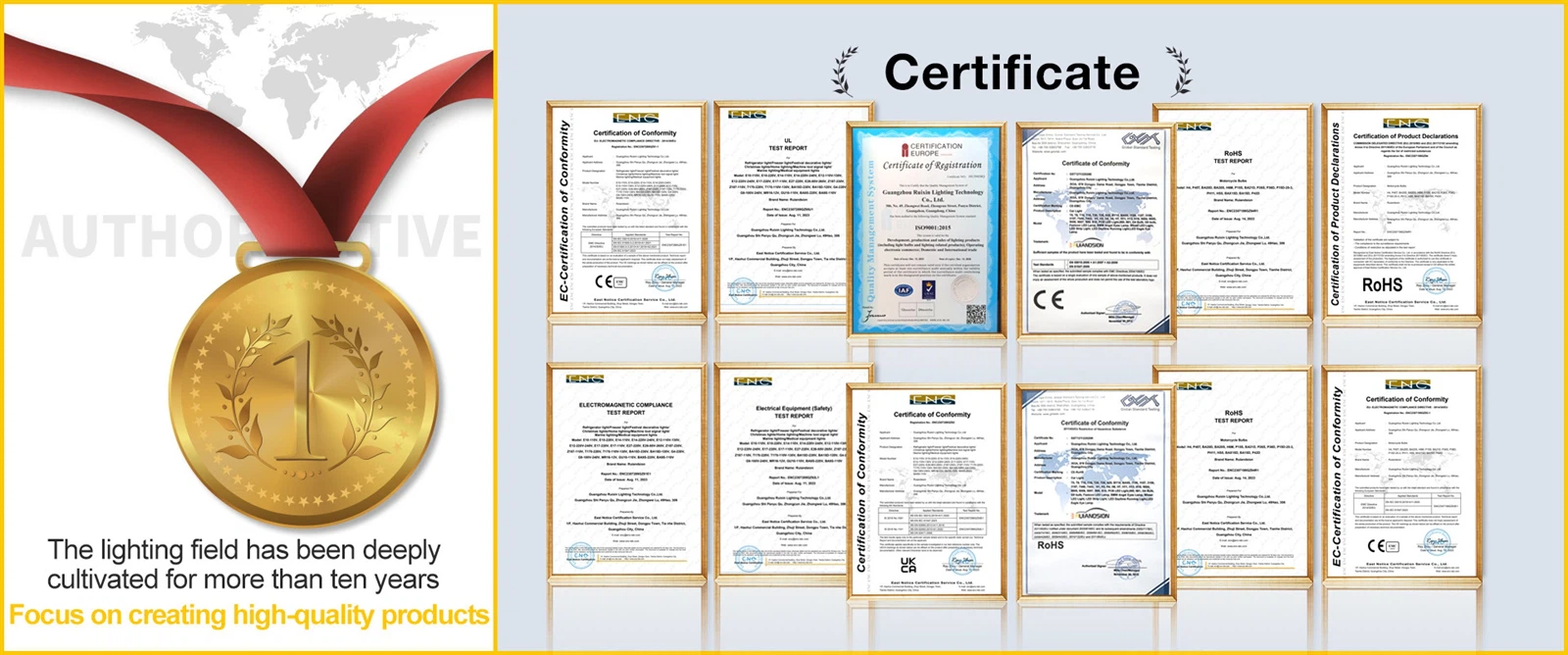
Certificate
Motorcycle Bulbs CE Certificate, Motorcycle Bulbs EMC Test Report, Motorcycle Bulbs LVD Test Report, Motorcycle Bulbs RoHS Report, Motorcycle Bulbs RoHS Certificate, Refrigerator Light-BS-EMC Test Report, Refrigerator Light-BS-Safety Test Report, Refrigerator Light-CE Certificate, Refrigerator Light-EMC Test Report, Refrigerator Light-LVD Test Report, Refrigerator Light-UKCA Certificate, Refrigerator Light-UL 1993 Test Report
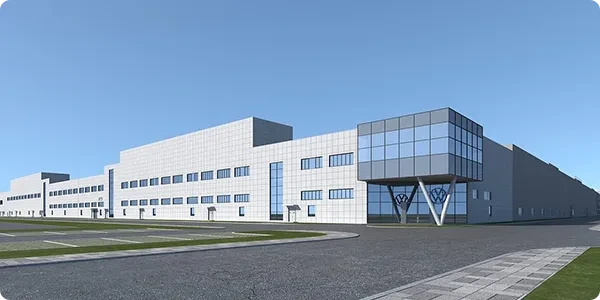
Guangzhou Ruiandsion Lighting Technology Co., Ltd. is a manufacturer specializing in the production of LED lighting for household, medical, industrial, automotive, and motorcycle applications. We have 12 years of production experience and have professional designers, sample craftsmen, quality inspectors, and production equipment. With strict quality management, innovative product technology, and a comprehensive service system, we have established long-term cooperation with customers from 45 countries worldwide.
FAQ
Q: What is an industrial light bulb called?
Q: What is the difference between domestic and industrial bulbs?
Q: What are the 4 types of light bulbs?
Q: Do you need an electrician to change a light bulb?
Q: Is it safe to change a light fixture yourself?
Q: Do you need to turn off power to change light fixture?
Q: Do LED lights get hot?
Q: What are the 3 light bulb colors?
Warm White Light ranges from 2700K to 3500K. ...
Natural White Light is in the 3500K to 4500K range. ...
Daylight White Light ranges from 5000K-6000K. ...
Cool White Light is between 6000K and 7000K.
Q: Can LED lights be left on 24 7?
Q: How do you tell if a light bulb is LED or incandescent?
Q: Do LED lights get dimmer over time?
Q: Do LED lights need batteries?
Q: Where should you not use LED lights?
Q: Is it OK to sleep with LED strip lights on?
Q: Is it OK to leave LED lights on at night?
Q: How hot does a 60 watt LED bulb get?
The higher the wattage of a light bulb, the more heat it will produce. A 60-watt bulb can get up to 200 degrees Fahrenheit on the bulb's glass surface. A 40-watt bulb can reach temperatures over 100 degrees Fahrenheit.
Q: Do LEDs get as hot as incandescent?
Q: What happens if I use an LED bulb in a dimmer?
Q: Can you run LED lights off a power bank?
Q: What is the whitest light bulb?
We're well-known as one of the leading industrial light bulbs suppliers in China. If you're going to wholesale high quality industrial light bulbs, welcome to get free sample from our factory. Also, customized service is available.
ba9s led 12v, Ba20d H6 Motorbike Led Bulbs, 7440 amber led