

Exterior Bulbs
Company Overview
Guangzhou Ruiandsion Lighting Technology Co., Ltd. was established in 2011 and is located in Guangzhou, Guangdong Province, mainly engaged in production and operation; The company has been committed to industries such as automobiles, household, medical, and industrial LED lighting for many years, effectively promoting cooperation with major enterprises, and serving society and the loyal users of Ruiandsion with the idea of industrial development.
Why Choose Us
Company Status
With strict quality management, innovative product technology, and a comprehensive service system, we have established long-term cooperation with customers from 45 countries worldwide.
Rich Experience
We have 12 years of production experience and have professional designers, sample craftsmen, quality inspectors, and production equipment.
Professional Team
Our team always adhere to customer demand orientation, continuously optimize product design and quality, has won the trust and praise of a large number of users.
24H Online Service
We have professional sales customer service to answer your product knowledge, introduce product functions and usage methods.
-
![Ruiandsion Customized 6 Volt Motorcycle Light Bulbs Replacement 6-30V White Warm White]() Ruiandsion Customized 6 Volt Motorcycle Light Bulbs Repla...Brand: Ruiandsionread more
Ruiandsion Customized 6 Volt Motorcycle Light Bulbs Repla...Brand: Ruiandsionread more
Socket: P15S
P15S-3014-12-6-30VAC-W
P15S-3014-12-6-30VAC-WW
Chip:Ruiandsion 3030 LED*12
Voltage:6-30V... -
![Ruiandsion Super Bright P15S Motorcycle Bulbs Made In China 6-30V White Warm White]() Ruiandsion Super Bright P15S Motorcycle Bulbs Made In Chi...Brand: Ruiandsionread more
Ruiandsion Super Bright P15S Motorcycle Bulbs Made In Chi...Brand: Ruiandsionread more
Socket: P15S
P15S-3030-12-6-30VAC-W
P15S-3030-12-6-30VAC-WW
Chip:Ruiandsion 3030 LED*12
Voltage:6-30V... -
![Ruiandsion BA15D 2003 Chevy S10 Tail Light Bulb For Sale Supplier White 6-24V]() Ruiandsion BA15D 2003 Chevy S10 Tail Light Bulb For Sale ...Brand: Ruiandsionread more
Ruiandsion BA15D 2003 Chevy S10 Tail Light Bulb For Sale ...Brand: Ruiandsionread more
Socket: BA15D
BA15D-2525-16-W-6-24V
Chip:Ruiandsion 2525 LED*16
Voltage:6-30V
Feature:Non-polarity
Lumen:860Lm/bulb... -
![Ruiandsion 1157 Bay15d Car Light Bulb Kits In Stock 6-30V Warm White]() Ruiandsion 1157 Bay15d Car Light Bulb Kits In Stock 6-30V...Brand: Ruiandsionread more
Ruiandsion 1157 Bay15d Car Light Bulb Kits In Stock 6-30V...Brand: Ruiandsionread more
Socket: 1157/BAY15D
Voltage: 6-30V
Color: Warm White
Power: 5.4W
Lumen:1300Lm
Current Output:High Beam 0.45A/12V Low Beam:0.09A/12V... -
![Ruiandsion 1156 BAU15S PY21W Turn Signal Lights Bulb For Cars 6V Warm White White]() Ruiandsion 1156 BAU15S PY21W Turn Signal Lights Bulb For ...Brand: Ruiandsionread more
Ruiandsion 1156 BAU15S PY21W Turn Signal Lights Bulb For ...Brand: Ruiandsionread more
Socket: ZS1156-3014-12-6V-WW/W
Voltage: 6V,12V,24V,48V
Color: Warm White(2800-3000K),White(6000K-6500K)
LED Quantity&Chips: 12SMD 3014 Chips -
![Ruiandsion 1156 BA15S LED turn signal lights for trucks 12V 24V 36V Yellow White Red]() Ruiandsion 1156 BA15S LED turn signal lights for trucks 1...Brand: Ruiandsionread more
Ruiandsion 1156 BA15S LED turn signal lights for trucks 1...Brand: Ruiandsionread more
Socket: FLS1156-5630-18-10-60V-Y
Voltage: 10-60V
Color: White(6000K-6500K),Yellow,Red
LED Quantity&Chips: 18SMD 5630 Chips -
![Ruiandsion 3157 led reverse bulb White Pink purple 12V]() Ruiandsion 3157 led reverse bulb White Pink purple 12VBrand: Ruiandsionread more
Ruiandsion 3157 led reverse bulb White Pink purple 12VBrand: Ruiandsionread more
Socket: DX3157-5050-27-12V-W/P
Voltage: 12V
Color: White,Pink,Purple
LED Quantity&Chips: 27SMD 5050 Chips -
![Ruiandsion 7440 Bulb Red Color Manufactory From China]() Ruiandsion 7440 Bulb Red Color Manufactory From ChinaBrand: Ruiandsionread more
Ruiandsion 7440 Bulb Red Color Manufactory From ChinaBrand: Ruiandsionread more
Socket: T20 7440 7443
Voltage: 10-60V
Color: White(6000K-6500K),Yellow,Red
LED Quantity&Chips: 3D Chips -
![Ruiandsion China T15 led backup light manufacturers 12V 24V Amber Yellow]() Ruiandsion China T15 led backup light manufacturers 12V 2...Brand: Ruiandsionread more
Ruiandsion China T15 led backup light manufacturers 12V 2...Brand: Ruiandsionread more
Socket: W2.1x9.5d T15
Voltage: 10-30V
Color: Amber Yellow
LED Quantity&Chips: Cree XBD Chips -
![Ruiandsion Hot Sale T15 China Led Bulb Factory 12V 24V White]() Ruiandsion Hot Sale T15 China Led Bulb Factory 12V 24V WhiteBrand: Ruiandsionread more
Ruiandsion Hot Sale T15 China Led Bulb Factory 12V 24V WhiteBrand: Ruiandsionread more
Socket: W2.1x9.5d T15
Voltage: 10-30V
Color: White(6000K-6500K),Yellow,Red
LED Quantity&Chips: Cree xbd Chips -
![Ruiandsion China T15 Car Reverse Led Light Suppliers 12V 24V White]() Ruiandsion China T15 Car Reverse Led Light Suppliers 12V ...Brand: Ruiandsionread more
Ruiandsion China T15 Car Reverse Led Light Suppliers 12V ...Brand: Ruiandsionread more
Socket: T15/W16W/921/912
Voltage: 10V-30V
Color: White(6000K-6500K)
LED Quantity&Chips: 6SMD 3030 Chips -
![1156 BA15S LED Bulb Universal AC/DC Voltage Ideal for Cars Trucks and SUVs At 12V and 24V Yellow Light 2700K]() 1156 BA15S LED Bulb Universal AC/DC Voltage Ideal for Car...Brand: Ruiandsionread more
1156 BA15S LED Bulb Universal AC/DC Voltage Ideal for Car...Brand: Ruiandsionread more
Socket: 1156 BA15S/ P21W
Voltage: 12V,24V
Color: White(6000K-6500K)
LED Quantity&Chips: 33SMD 2835 Chips


Advantages of Exterior Bulbs
Improving safety
The main function of turn signals is to enhance the safety of drivers and other road users. When the driver turns on the turn signals, they will emit bright lights to inform other drivers of their driving intentions, which helps to avoid traffic accidents.
Increase visibility
Exterior bulbs are particularly important at night or in situations with poor visibility. They can greatly enhance the visibility of the vehicle, making it easier for other drivers to notice your vehicle and avoid collisions.
Provide clear instructions
Exterior bulbs flash to clearly indicate the direction of vehicle travel, allowing other drivers to clearly understand your driving intentions and make appropriate responses.
Compliance with traffic regulations
In many countries and regions, the use of turn signals is a part of traffic regulations. Using turn signals not only helps you avoid traffic accidents, but also ensures that you comply with traffic regulations and avoid fines or other legal penalties.
Improving driving efficiency
Turn signals can help drivers predict the driving intentions of other drivers more accurately, thereby improving driving efficiency and reducing traffic congestion.
Things to Consider When Buying Exterior Bulbs


Bulb Type and Compatibility
The first and most crucial consideration when buying exterior bulbs is the bulb type and compatibility. Not all vehicles use the same type of turn signal bulb, and it's essential to ensure that the bulbs you choose are compatible with your vehicle's make and model. Common turn signal bulb types include 1157, 3157, 7443, and more. Consult your vehicle's manual or check the existing bulbs to determine the correct bulb type. LED blinker lights offer a modern and efficient solution for your vehicle's signaling needs, ensuring you stand out on the road.
Bulb Brightness
The brightness of the exterior bulbs is measured in lumens. The higher the lumen rating, the brighter the bulb. When selecting exterior bulbs, consider your specific lighting needs. A brighter turn signal is especially crucial for increasing visibility in challenging conditions, such as inclement weather or bright sunlight. Opt for bulbs with an appropriate lumen rating to ensure that your turn signals are clearly visible to others on the road.
Color Temperature
Color temperature, measured in Kelvin (K), affects the perceived color of the light. While most exterior bulbs emit an amber light to meet legal requirements, it's essential to select bulbs that match your vehicle's specifications. Bulbs that deviate significantly from the standard amber color may not be street-legal, so make sure to check local regulations and vehicle requirements. Discover cutting-edge LED technology and upgrade your vehicle's lighting system on the homepage of SEALIGHT today.
Beam Pattern
The beam pattern of a exterior bulbs bulb determines how the light is distributed. A well-defined and focused beam pattern is essential for effective signaling. It ensures that the light is evenly distributed and easily visible to other drivers. Consider exterior bulbs with a precise and uniform beam pattern to make your intentions clear to everyone on the road.
Durability and Lifespan
Durability and longevity are crucial factors when buying exterior bulbs. You want bulbs that can withstand the rigors of everyday driving and provide reliable performance. LED turn signal bulbs are known for their long lifespan and resistance to vibrations, making them a durable choice. Be sure to select bulbs with a reputation for reliability to minimize maintenance and replacements.
Ease of Installation
The ease of installation is an essential consideration, especially if you plan to replace the bulbs yourself. Some exterior bulbs feature a plug-and-play design, making installation straightforward and accessible even to those with minimal automotive expertise. Review the installation process for the bulbs you're considering to ensure it aligns with your skill level and tools available.
Brand and Quality
When buying exterior bulbs, consider the reputation and quality of the brand. Well-established and trusted brands often offer high-quality bulbs with better performance and reliability. Research customer reviews and ratings to gain insights into the experiences of other vehicle owners with the same bulbs.
Heat Dissipation
LED exterior bulbs generate heat during operation, and efficient heat dissipation is essential to maintain performance and extend the bulb's lifespan. High-quality bulbs often incorporate advanced heat management systems, such as heat sinks and fans, to prevent overheating.
Price and Warranty
While price is a consideration, it should not be the sole determining factor when buying exterior bulbs. Opt for bulbs that offer a balance between cost and quality. Keep in mind that investing in higher-quality bulbs may result in longer lifespan and reduced maintenance costs over time. Additionally, consider whether the bulbs come with a warranty, as it provides added peace of mind and protection in case of defects.
Local Regulations and Requirements
Local regulations and requirements can vary, so it's crucial to understand the specific rules governing exterior bulbss in your area. Ensure that the bulbs you choose meet all legal requirements and are street-legal to avoid potential legal issues or fines.
As we all know, turn signals are how you communicate with other motorists on the road. You use them to make known your intent of either changing direction, changing lanes and sometimes when you want to overtake. It is therefore absolutely crucial that your exterior bulbs are in good working order as they play a big role in preventing accidents.
One of the simplest ways of telling whether one of the exterior bulbs is damaged is by the fast blinking of the signal indicators located on the dashboard. This is brought about by the less electrical load.
It's quite obvious now that if your car still has halogen bulbs, you need to quickly switch over to LED car lights. This is especially true with the exterior bulbs. Most of the LED exterior bulbs are situated either at the side or much further down than other LED auto lights. This makes them prone to damage from getting knocked by objects.
That is...if they were not built to last. Incandescent bulbs will quickly come to the end of their life if they are broken. LED exterior bulbs can withstand a lot of external pressure which makes them durable. You save on your cash as well as you do not have to replace them regularly. And you've got to admit how sleek the car looks with those LED exterior bulbs on. It will definitely raise your car's aesthetics.
One great benefit of exterior bulbs is that they are bright. This makes it that that much easier for you to be seen by the other motorists allowing them to give you way or act accordingly.
The high number of vehicles in our cities means that there will almost always be a time when you are stuck in traffic. One of the easiest ways to collide with another car is when your exterior bulbs cannot be seen clearly. The fact that LED exterior bulbs are bright makes them simple to spot. This allows you to maneuver easily through the other cars which will also help you get to your destination quicker.
An important component that goes with installing LED exterior bulbs is load resistors. Without these resistors, also called equalizers, you may soon find your lights flashing as if being possessed. The last thing you want is to be stopped by the traffic police.
The flashing is brought about by too much charge reaching the LED exterior bulbs. For an LED to work at its optimum, the charge needs to be within the limits that the LED can handle. Too much voltage and the LED car lights would get burnt. This is why it is important to add a load resistor.
However, this is not a rule cast in stone and there are ways you can bypass the need to use a resistor. If you can lower the input voltage to the same level as the forward voltage on the LED, then you are set to go.
Maintenance Tips for Exterior Bulbs
Choose the Right exterior bulbs
Different environments may require different types of exterior bulbs. As a result, choosing the correct brightness, wattage, and color temperature is essential. For example, certain LED lights are suitable for office spaces, while others work better in industrial areas.
Regulate the Temperature
Although LED exterior bulbs stand up better to hot temperatures than other exterior bulbs, you should still maintain a cooler temperature around them. If you expose your exterior bulbs or fixtures to higher temperatures, they may start to lose efficiency and burn out. Many LED exterior bulbs can withstand temperatures of up to 185 Fahrenheit before failing, but you should try to ensure they don't come close to that.
Reduce Humidity
Another essential LED lighting maintenance tip is to watch the humidity levels. Excessive moisture in the air can cause lasting damage to the electronic components inside the exterior bulbs. When working in humid workspaces, ensure there's proper ventilation and a dehumidifier if necessary.
Clean Them Regularly
One of the largest advantages of LED exterior bulbs is their longevity. However, because these exterior bulbs can last for years before they burn out, many people neglect to clean them and the areas around them. Built-up dust can short out your exterior bulbs and cut their lifespan, so remember to perform an annual or semi-annual cleaning of your light fixtures to protect your exterior bulbs.
Inspect Them Routinely
When performing maintenance, getting regular inspections of your lights is always a good idea. A licensed technician may help you determine if there are any issues with the electronic components in your exterior bulbs or if you need to adjust the wiring in your fixtures.
How Do Exterior Bulbs Work?
An exterior bulbs produces light by passing the electric current through a semiconducting material—the diode—which then emits photons (light) through the principle of electroluminescence.
This essentially means that a material (in this case, the diode) casts light when power is applied to it, hence the phase light emitting diodes. Electrons jump from one side (an electron-full side) to another (an electron-deficient side) across a junction (the “p-n junction”). Think of it this way: When power is applied to the p-n junction, the side lacking in electrons wants to be filled up with the charged electrons from the other side, and when power is applied the electrons get eager to move. During this process, light is created.
In contrast, an incandescent light bulb works by passing electricity through a small wire, or filament. The electrical resistance of the filament causes it to get so hot that it glows, producing light.
The fact that exterior bulbs do not rely on heat to produce its light means it runs cooler and is much more energy-efficient than an incandescent light bulb.
Certificate
Motorcycle Bulbs CE Certificate, Motorcycle Bulbs EMC Test Report, Motorcycle Bulbs LVD Test Report, Motorcycle Bulbs RoHS Report, Motorcycle Bulbs RoHS Certificate, Refrigerator Light-BS-EMC Test Report, Refrigerator Light-BS-Safety Test Report, Refrigerator Light-CE Certificate, Refrigerator Light-EMC Test Report, Refrigerator Light-LVD Test Report, Refrigerator Light-UKCA Certificate, Refrigerator Light-UL 1993 Test Report
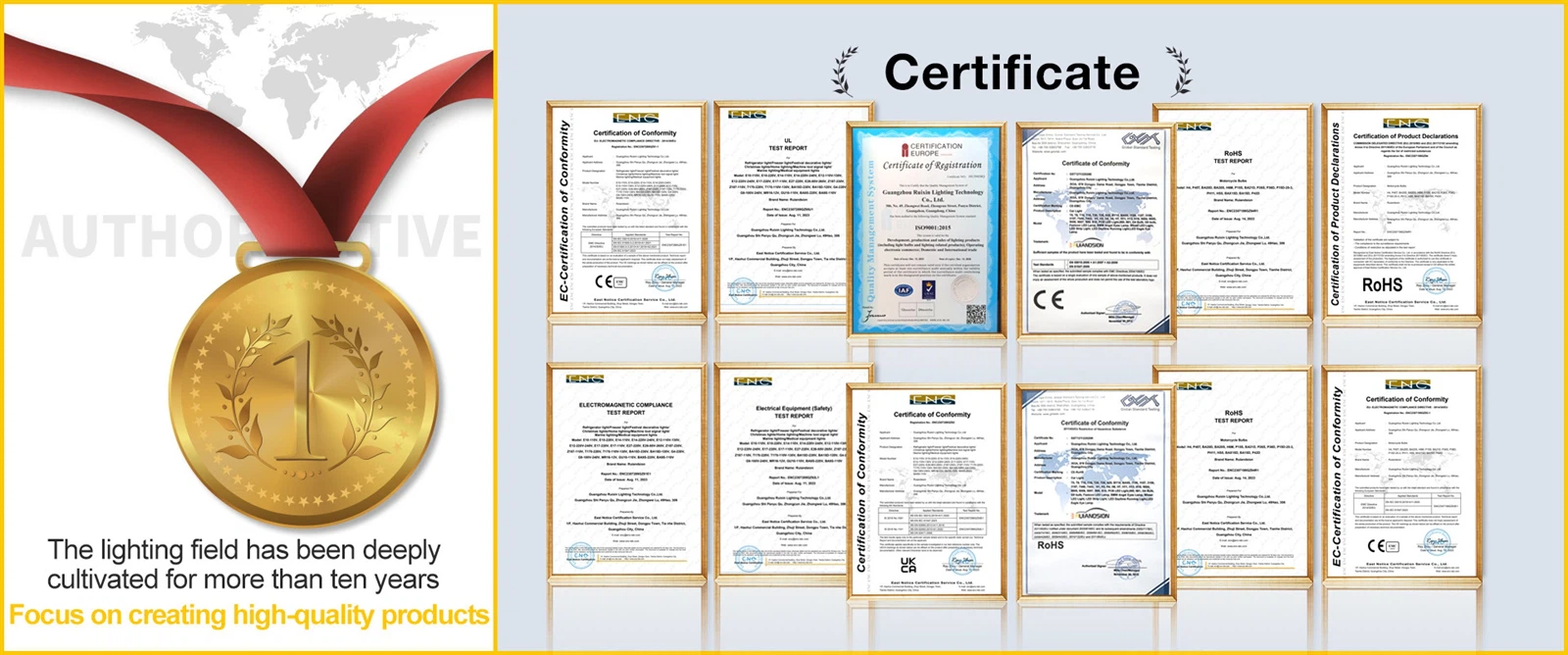

Guangzhou Ruiandsion Lighting Technology Co., Ltd. is a manufacturer specializing in the production of LED lighting for household, medical, industrial, automotive, and motorcycle applications. We have 12 years of production experience and have professional designers, sample craftsmen, quality inspectors, and production equipment. With strict quality management, innovative product technology, and a comprehensive service system, we have established long-term cooperation with customers from 45 countries worldwide.
FAQ
Q: Will an LED bulb work if wired backwards?
Q: Are LED reverse lights worth it?
Q: Can LEDs be installed backwards?
Q: What happens if we put LED in the reverse direction?
Q: Do LED bulbs have a positive and negative?
For an LED to work it needs to be connected to a voltage source with the correct side. The voltage supply side of the diode is the positive (+) side, this is called the anode. The negative side is called the cathode.
Q: Where should you not use LED lights?
Q: What is the reverse button on LED lights?
Q: Do LED bulbs get hot?
Q: Why do my LED lights burn out so quickly?
Q: Why do LED lights go out so quickly?
Q: Do LED bulbs really last 10 years?
Q: Is a reverse light the same as a brake light?
Q: What is the difference between 3157 and 7443?
Q: How do I know what brake bulb I need?
Q: Do all cars have white reverse lights?
Q: Can you drive without a reverse light?
Q: Is the reverse light and brake light the same?
Q: Do all cars have 2 brake lights?
Q: Do brake lights have to be red?
Q: Can I put LED bulbs in my tail lights?
We're well-known as one of the leading exterior bulbs suppliers in China. If you're going to wholesale high quality exterior bulbs, welcome to get free sample from our factory. Also, customized service is available.
trailer back up light, 3156 3157, Miniature Indicator Lamps Light Bulb