

Home Light Bulbs
Company Overview
Guangzhou Ruiandsion Lighting Technology Co., Ltd. was established in 2011 and is located in Guangzhou, Guangdong Province, mainly engaged in production and operation; The company has been committed to industries such as automobiles, household, medical, and industrial LED lighting for many years, effectively promoting cooperation with major enterprises, and serving society and the loyal users of Ruiandsion with the idea of industrial development.
Why Choose Us
Company Status
With strict quality management, innovative product technology, and a comprehensive service system, we have established long-term cooperation with customers from 45 countries worldwide.
Rich Experience
We have 12 years of production experience and have professional designers, sample craftsmen, quality inspectors, and production equipment.
Professional Team
Our team always adhere to customer demand orientation, continuously optimize product design and quality, has won the trust and praise of a large number of users.
24H Online Service
We have professional sales customer service to answer your product knowledge, introduce product functions and usage methods.
-
![Ruiandsion E14 Super Bright Led House Bulbs 85-265V Red Suppliers]() Ruiandsion E14 Super Bright Led House Bulbs 85-265V Red S...Brand: Ruiandsionread more
Ruiandsion E14 Super Bright Led House Bulbs 85-265V Red S...Brand: Ruiandsionread more
Socket: E14
Chip:Ruiandsion 2835 LED*24
Voltage:85V-265V
Lumen:720Lm/bulb
Power:2W
Beam angle:360 degree... -
![Ruiandsion Super Bright E10 Best Led Flashlight Bulb OEM ODM 12V Yellow]() Ruiandsion Super Bright E10 Best Led Flashlight Bulb OEM ...Brand: Ruiandsionread more
Ruiandsion Super Bright E10 Best Led Flashlight Bulb OEM ...Brand: Ruiandsionread more
Socket: E10
Chip:Ruiandsion 2835 LED*12
Voltage:12V
Feature:Non-polarity
Lumen:360Lm/bulb
Power:2.16W
Current... -
![Ruiandsion 1156 Ba15s Super Bright LED Metal Indicator Light Bulb AC6-30V White Warm White]() Ruiandsion 1156 Ba15s Super Bright LED Metal Indicator Li...Brand: Ruiandsionread more
Ruiandsion 1156 Ba15s Super Bright LED Metal Indicator Li...Brand: Ruiandsionread more
Socket: XC1156-3030-8-AC6-30V-W-MW
XC1156-3030-8-AC6-30V-WW-MW
Chip:Ruiandsion 3030 LED*8
Voltage:AC6V-30V
Power:1.44W... -
![Ruiandsion E14 Decorative Smart Bulbs Replacement 6-30V White Warm White]() Ruiandsion E14 Decorative Smart Bulbs Replacement 6-30V W...Brand: Ruiandsionread more
Ruiandsion E14 Decorative Smart Bulbs Replacement 6-30V W...Brand: Ruiandsionread more
Socket: E14 Screw
Chip:Ruiandsion 3030 LED*8
Voltage:AC6V-30V
Power:1W
Color:White/Warm White
Beam Angel:360 degree MOQ:100PCS -
![Ruiandsion E12 Small Base Round Screw Light Bulb 6V 12V 24V White Warm White]() Ruiandsion E12 Small Base Round Screw Light Bulb 6V 12V 2...Brand: Ruiandsionread more
Ruiandsion E12 Small Base Round Screw Light Bulb 6V 12V 2...Brand: Ruiandsionread more
Socket: XCE12-3030-8-AC6-30V-W-MW
XCE12-3030-8-AC6-30V-WW-MW
Chip:Ruiandsion 3030 LED*8
Voltage:AC6V-30V
Power:1W
Color:White/Warm... -
![Ruiandsion E17 Decorative Lighting For Home Gifting Supplier 85-265V White Warm White]() Ruiandsion E17 Decorative Lighting For Home Gifting Suppl...Brand: Ruiandsionread more
Ruiandsion E17 Decorative Lighting For Home Gifting Suppl...Brand: Ruiandsionread more
Socket: DDT18SS-224-E17-2835-24-85-265V-W
DDT18SS-224-E17-2835-24-85-265V-WW
Chip:Ruiandsion 2835 LED*24 Voltage:AC85-265V
Lumen:720Lm/bulb... -
![Ruiandsion E10 Flashlight Bulb Torch Bulbs Work Lights For Sale 3V 4.5V 6V 12V 24V]() Ruiandsion E10 Flashlight Bulb Torch Bulbs Work Lights Fo...Brand: Ruiandsionread more
Ruiandsion E10 Flashlight Bulb Torch Bulbs Work Lights Fo...Brand: Ruiandsionread more
Socket: TYE10-2016-9-3V-WW
Voltage:1.1V
Color:Warm White(4300K)
Output:0.3A
Lumen:100Lm/bulb
Power:0.33W
MOQ:100PCS -
![Ruiandsion B9 Led Flashlight Bulb Replacement Miniature Flashlight Bulbs 1.2V Warm White]() Ruiandsion B9 Led Flashlight Bulb Replacement Miniature F...Brand: Ruiandsionread more
Ruiandsion B9 Led Flashlight Bulb Replacement Miniature F...Brand: Ruiandsionread more
Socket: WHE10-1.1V-0.3A-WW
Voltage:1.1V
Color:Warm White(4300K)
Output:0.3A
Lumen:100Lm/bulb
Power:0.33W
MOQ:100PCS -
![Ruiandsion E10 Bat Flashlight X Torch Anker Flashlight 1.1V Warm White]() Ruiandsion E10 Bat Flashlight X Torch Anker Flashlight 1....Brand: Ruiandsionread more
Ruiandsion E10 Bat Flashlight X Torch Anker Flashlight 1....Brand: Ruiandsionread more
Socket: WHE10-1.1V-0.3A-WW
Voltage:1.1V/
Color:Warm White(4300,)
Output:0.3A
Lumen:100Lm/bulb
MOQ:100PCS -
![Ruiandsion E10 Mini Mag Flashlight Bulbs Torch Light Bulbs 1.5V Warm White]() Ruiandsion E10 Mini Mag Flashlight Bulbs Torch Light Bulb...Brand: Ruiandsionread more
Ruiandsion E10 Mini Mag Flashlight Bulbs Torch Light Bulb...Brand: Ruiandsionread more
Socket: WHE10-1.5V-0.3A-WW
Voltage:1.5V/
Color:Warm White(4300,)
MOQ:100PCS -
![Ruiandsion E10 Miniature Screw Bulbs Flashlights Torch Bike Lights 12V 24V White Warm White]() Ruiandsion E10 Miniature Screw Bulbs Flashlights Torch Bi...Brand: Ruiandsionread more
Ruiandsion E10 Miniature Screw Bulbs Flashlights Torch Bi...Brand: Ruiandsionread more
Socket: XCE10-7020-3
Voltage:6V/12V/24V
Color: White(6000K)/Warm White(4300,)
LED Quantity&Chips: 3SMD 7020 Chips
MOQ:100PCS -
![Ruiandsion E10 Mini Maglite Bulb Led Flashlight Bulbs 6V 3030 4SMD Chips Yellow Torch Bike Work Light Non Polarity]() Ruiandsion E10 Mini Maglite Bulb Led Flashlight Bulbs 6V ...Brand: Ruiandsionread more
Ruiandsion E10 Mini Maglite Bulb Led Flashlight Bulbs 6V ...Brand: Ruiandsionread more
Socket: YGE10-3030-4-6V-Yellow
Voltage:6V
Color: Yellow(2300K)
LED Quantity&Chips: 4SMD 3030 Chips
MOQ:100PCS


Advantages of Home Light Bulbs
The lifespan of a typical incandescent bulb or compact fluorescent light is defined by how long it lasts before burning out. LEDs light bulbs are not measured that way. Instead, LED lighting will experience 'lumen depreciation', which means its brightness declines over time. The life cycle of LED lights is usually defined by a prediction of when it will hit a 30 percent decrease in light output.
Everyone is looking for ways to save money, and LED lighting can help you do just that. Compared to incandescent bulbs, LEDs lights produce light up to 90 percent more efficiently. This could make a significant impact on your electricity bill.
Energy-efficient products are typically better for the environment and LED lights are no exception. LED lighting is an environmentally friendly way to light up your home.. LED lights are also manufactured differently than some other lighting sources such as fluorescent and mercury vapor lights. These types of lights use mercury and must be disposed of properly once they reach their end of life. You don't have to worry about that with LED lights.
Did you know traditional lighting sources perform worse in cold conditions? Light sources may need higher voltage to start, and their brightness may diminish. In other words, they use more energy but produce less light. This is not the case for LED lighting, which performs better in the cold. This why they are useful outdoors, in freezers or cold storage, on building perimeters, and in outdoor signage.
Have you ever touched an incandescent light bulb after it has been on for a while? You may be familiar with how hot these light bulbs can get. Even when you put your hand near an incandescent light bulb, you will feel excess heat emitting from it. If you are comparing the benefits of LED lighting vs incandescent bulbs, you will notice that LED lights emit almost no heat. Most of the energy used by LED light bulbs is emitted as light.
Basics of Home Light Bulbs
Before getting into the shapes, sizes, and uses of home light bulbs, here are commonly used terms to know when shopping for home lighting.
Light bulb wattage
Watts measure how much power or energy a home light bulbs uses. Higher-wattage home light bulbs require more energy, resulting in a higher electric bill.
Incandescent bulbs have high wattage, making them highly energy inefficient. This is why new United States regulations have banned most incandescents in favor of lower wattage and more energy-efficient bulbs like LEDs.
Both bulb types emit the same amount of light despite their wattage differences.
Light bulb lumens
Lumens refer to how much light a bulb gives off. If a bulb has more lumens, it will have a brighter light.

Importance of Home Light Bulbs in Daily Life
Home home light bulbs play a crucial role in our daily lives, providing us with the necessary illumination to carry out various activities. From the moment we wake up until we go to bed, home light bulbs enhance our productivity, safety, and overall well-being. Here are some key reasons why home light bulbs are important in our daily life:
Task Lighting: Home home light bulbs provide task lighting, allowing us to effectively perform various activities such as reading, working, cooking, and hobbies. Whether it's a desk lamp, overhead lights in a kitchen, or a bright spotlight for focused tasks, home light bulbs provide the necessary illumination to facilitate our daily tasks and improve productivity.
Ambient Lighting: Home home light bulbs help create the ambiance and atmosphere in our homes and workplaces. Soft, warm lighting can create a cozy and relaxing environment, while bright, cool lighting can promote alertness and focus. By choosing the right home light bulbs for different spaces, we can enhance our mood, comfort, and overall well-being.
Safety and Security: Adequate lighting is essential for our safety and security in both indoor and outdoor settings. Well-lit areas help us navigate our surroundings, identify potential hazards, and prevent accidents. Outdoor lighting can deter crime and improve visibility during nighttime hours, providing a sense of safety in our communities.
Mental and Emotional Well-being: Home home light bulbs have a significant impact on our mental and emotional well-being. Exposure to natural daylight or artificial light that mimics it can help regulate our circadian rhythm, which affects our sleep patterns and overall mood. The right lighting can promote a sense of calm, improve focus, reduce eyestrain, and contribute to a positive living and working environment.
Decorative Purposes: Home home light bulbs are not just functional; they also serve as decorative elements in our living spaces. From elegant chandeliers to stylish pendant lights, light fixtures can enhance the aesthetics of a room, creating a visually appealing environment. With the variety of light bulb options available, we can choose different colors, shapes, and intensities to create the desired ambiance and style.
Energy Efficiency and Cost Savings: Choosing energy-efficient home light bulbs, such as LEDs, can lead to significant cost savings and reduced environmental impact. Energy-efficient bulbs consume less electricity, resulting in lower energy bills and reducing our carbon footprint. By making the switch to energy-efficient lighting solutions, we contribute to a more sustainable future.
How to Buy the Right Home Light Bulbs
Buying a home light bulbs is a little more complicated than it used to be. You can't just pick up a similar watt bulb and expect it will match the other bulbs in the room, or even work in your fixture. So before you purchase your next bulb, you should arm yourself with these five facts.
Home light bulbs come in a variety of sizes and shapes, depending on where you're using them. The standard home light bulbs used in U.S. households is an A19 bulb with E26 base. The E means that the bulb has an Edison Screw and the 26 means the base is 26mm across (in Europe you'll find E27 bulbs). The A refers to the bulb shape. A is for arbitrary and is the shape that we all think of when we envision a home light bulbs (C is for candle, G is for Globe etc.) The number 19 designates the size. Bulbs.com has a great home light bulbs shape chart for reference. The site also has a handy home light bulbs base chart.
Wattage is no longer the best way to determine which bulb will be a direct replacement for the bulb that just burned out. Instead of watts, look for the number of lumens, the measure of how much light a bulb produces rather than how much energy it uses. You'll usually also see a watt equivalent, but to be sure, look for the lumens. Here's a cheat sheet for replacing incandescent bulbs.
White home light bulbss have a color cast. They can be the warm, yellow light of the traditional incandescent home light bulbs, the cool, blue light of daylight or somewhere in between. Manufacturers like to use terms like "soft" or "warm" or "daylight." Unfortunately, these terms aren't standard across manufacturers. To determine the direct color replacement, you should look at the color temperature, which is measured in degrees Kelvin.
Not all home light bulbss can be dimmed or used in 3-way fixtures, especially compact fluorescent and LED bulbs. The packaging should specifically say that the bulb is "dimmable" or "3-way" in order for you to know that the bulb will indeed work with your dimmer or 3-way fixture.
Home light bulbs that are used in enclosed fixtures and recessed fixtures heat up more than if they're used in open fixtures. LED bulbs are especially sensitive to heat won't last as long if used in these types of fixtures. If you want your LED bulb to last longer, make sure you look for a bulb that rated for use in a enclosed fixture. You can find enclose-fixture rated LED bulbs on Amazon.
When you're buying new bulbs—no matter the type—you'll want to look for the Energy Star label. Energy Star certified home light bulbss are tested to meet energy efficiency standards and will include labeling to tell you exactly what you're buying. The Energy Star label will show the bulb's brightness (in lumens), color (i.e. color temperature), lifespan, energy usage, and what it will cost to run it for a year. This information makes it easy to compare bulbs, especially if you're considering bulbs of different types.
5 Important Things to Look for in Choosing the Right Home Light Bulbs
Focus on Brightness
Different amounts of light are needed for different uses. Instead of thinking about home light bulbs based solely on the amount of energy they use, focus on their brightness level. Lumen is the measurement of brightness. Higher lumen bulbs produce brighter light. Watt is the measure of power consumption. Lower wattage bulbs can lower your electric bills. If you like your bulb’s current brightness, choose a CFL or LED with similar lumens to reduce your energy use. You may also consider a bulb that is less bright to save more.
Check the color temperature.
On new light bulb labels, you can find the bulbs' color temperature, measured on the Kelvin scale. The warmer light colors associated with incandescents are on the lower end of the scale. So if that's your preference, look for LEDs and CFLs with light color temperatures in the 2700K to 3000K range. Pure white light hovers around 4000K, while cooler temperatures that simulate daylight are 5000K or higher.
Longevity
While looking at watts when bulb shopping, next look at how long it lasts. Standard bulbs last 750 hours, while ours last 20,000 hours. The longer it lasts, the better the quality, and the better it is for the environment. 83% of our landfills are filling up, and it takes 500 years for a bulb to biodegrade. The longer lasting bulbs are simply less wasteful. Our rough service bulbs with 5 support wires and 2 lead wires are exempt from the incandescent ban, and are better quality. They can be used in any general lamp and are perfect for hard to reach areas such as the basement ceiling or above the staircase. They look the same as standard bulbs, last much longer, and they are the greener choice. It takes 20 bulbs to equal one of our 20,000 hour bulbs.
Price
When you buy a bulb, you are buying hours of time of light. While you can find a home light bulbs for as cheap as $1, it will only burn for one thousand hours. Ours are a bit more expensive, but last 20 times longer, meaning you are buying a bulb that costs 10 cents per 1,000 burning hours.
Look for the ENERGY STAR label.
Especially in LEDs, the manufacturing quality of the bulb varies, with lesser bulbs not lasting as long as their better-built counterparts. Lighting experts currently recommend only buying ENERGY STAR qualified LED home light bulbs, as they have to pass numerous quality tests to earn that designation.
Certificate
Motorcycle Bulbs CE Certificate, Motorcycle Bulbs EMC Test Report, Motorcycle Bulbs LVD Test Report, Motorcycle Bulbs RoHS Report, Motorcycle Bulbs RoHS Certificate, Refrigerator Light-BS-EMC Test Report, Refrigerator Light-BS-Safety Test Report, Refrigerator Light-CE Certificate, Refrigerator Light-EMC Test Report, Refrigerator Light-LVD Test Report, Refrigerator Light-UKCA Certificate, Refrigerator Light-UL 1993 Test Report
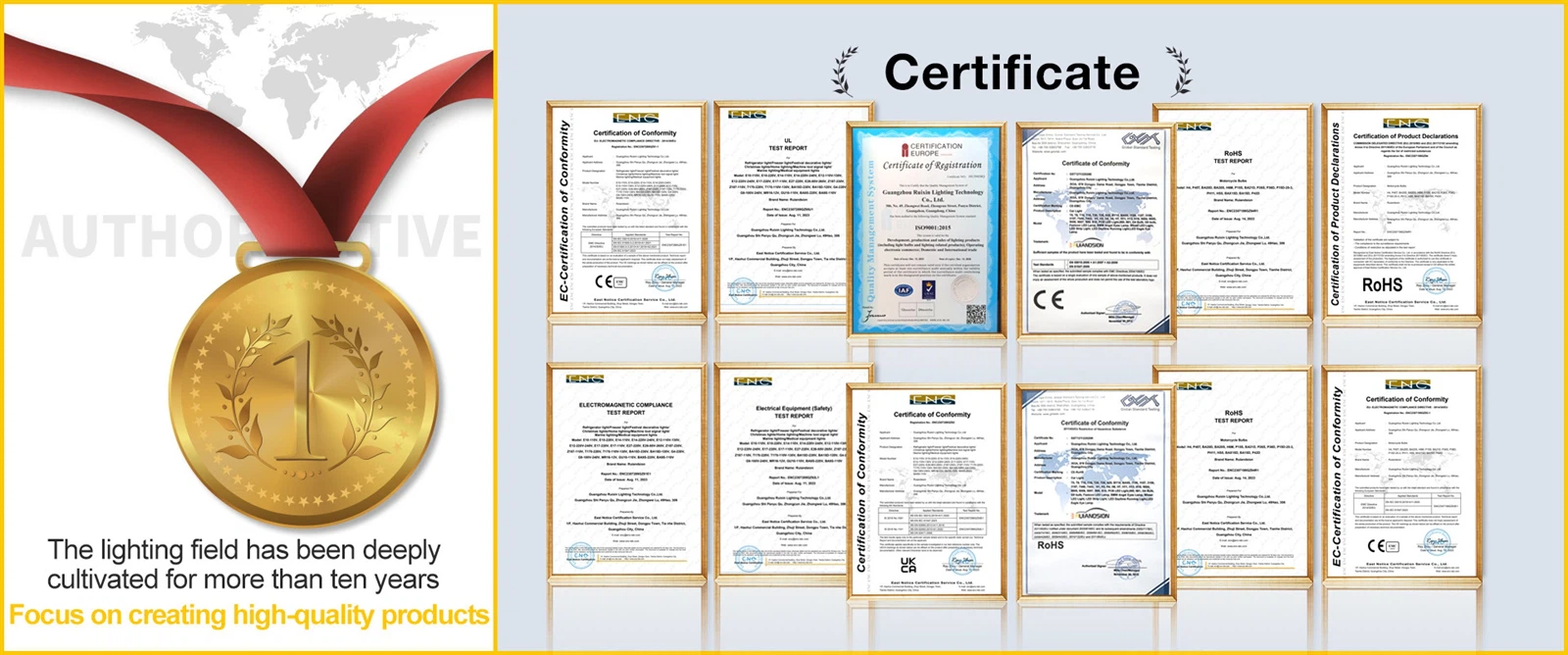

Guangzhou Ruiandsion Lighting Technology Co., Ltd. is a manufacturer specializing in the production of LED lighting for household, medical, industrial, automotive, and motorcycle applications. We have 12 years of production experience and have professional designers, sample craftsmen, quality inspectors, and production equipment. With strict quality management, innovative product technology, and a comprehensive service system, we have established long-term cooperation with customers from 45 countries worldwide.
FAQ
Q: What light bulbs should I use in my house?
Q: What are the best light bulbs for home showing?
Q: What are the 3 types of light bulbs?
Halogen, incandescent and fluorescent light bulbs all product different types of light.
Q: What is the most flattering light bulb for a house?
Q: What happens if you put a 60w LED bulb in a 40w socket?
Q: What is the best light bulb to avoid bugs?
Q: What is the best light bulb to leave on all night?
Q: How do you tell if a light bulb is LED or incandescent?
Q: What are the new light bulbs called?
Q: Why are incandescent light bulbs banned?
Q: What is the best bulb for a bedroom ceiling?
Q: What light bulbs do ceiling fans use?
Q: Can you put LED bulbs in old fixtures?
Q: Which bulb gives more light using less electricity?
LEDs use up to 90% less energy and last up to 25 times longer than traditional incandescent bulbs.
Q: What light bulb is closest to natural light?
Q: What light bulb do most houses use?
Q: What wattage should a bedroom light be?
As a general rule, most bedrooms require a total wattage of around 50-60 watts. This can be achieved by using a combination of overhead fixtures and table lamps. When choosing bulbs for your table lamps, consider using bulbs that are between 40-60 watts. For overhead fixtures, opt for bulbs that are around 60-75 watts.
Q: Where should you not use LED bulbs?
Q: Can I use a 60W LED bulb in a 40W lamp?
Q: How much does it cost to run an LED light bulb for 24 hours?
We're well-known as one of the leading home light bulbs suppliers in China. If you're going to wholesale high quality home light bulbs, welcome to get free sample from our factory. Also, customized service is available.
Canbus Ba9s T4w LED Car Bulb Back Lights 12V 24V For BMW, E10 LED Bulb Super Bright 600 Lumens, H16 5202 Canbus LED Fog Lights Bulb White