

Auto Light Bulb
Company Overview
Guangzhou Ruiandsion Lighting Technology Co., Ltd. was established in 2011 and is located in Guangzhou, Guangdong Province, mainly engaged in production and operation; The company has been committed to industries such as automobiles, household, medical, and industrial LED lighting for many years, effectively promoting cooperation with major enterprises, and serving society and the loyal users of Ruiandsion with the idea of industrial development.
Why Choose Us
Company Status
With strict quality management, innovative product technology, and a comprehensive service system, we have established long-term cooperation with customers from 45 countries worldwide.
Rich Experience
We have 12 years of production experience and have professional designers, sample craftsmen, quality inspectors, and production equipment.
Professional Team
Our team always adhere to customer demand orientation, continuously optimize product design and quality, has won the trust and praise of a large number of users.
24H Online Service
We have professional sales customer service to answer your product knowledge, introduce product functions and usage methods.
-
![Ruiandsion Customized 6 Volt Motorcycle Light Bulbs Replacement 6-30V White Warm White]() Ruiandsion Customized 6 Volt Motorcycle Light Bulbs Repla...Brand: Ruiandsionread more
Ruiandsion Customized 6 Volt Motorcycle Light Bulbs Repla...Brand: Ruiandsionread more
Socket: P15S
P15S-3014-12-6-30VAC-W
P15S-3014-12-6-30VAC-WW
Chip:Ruiandsion 3030 LED*12
Voltage:6-30V... -
![Ruiandsion Super Bright P15S Motorcycle Bulbs Made In China 6-30V White Warm White]() Ruiandsion Super Bright P15S Motorcycle Bulbs Made In Chi...Brand: Ruiandsionread more
Ruiandsion Super Bright P15S Motorcycle Bulbs Made In Chi...Brand: Ruiandsionread more
Socket: P15S
P15S-3030-12-6-30VAC-W
P15S-3030-12-6-30VAC-WW
Chip:Ruiandsion 3030 LED*12
Voltage:6-30V... -
![Ruiandsion BA15D 2003 Chevy S10 Tail Light Bulb For Sale Supplier White 6-24V]() Ruiandsion BA15D 2003 Chevy S10 Tail Light Bulb For Sale ...Brand: Ruiandsionread more
Ruiandsion BA15D 2003 Chevy S10 Tail Light Bulb For Sale ...Brand: Ruiandsionread more
Socket: BA15D
BA15D-2525-16-W-6-24V
Chip:Ruiandsion 2525 LED*16
Voltage:6-30V
Feature:Non-polarity
Lumen:860Lm/bulb... -
![Ruiandsion Deal Beam Led Bulb For Car H4 Replacement 6V White Yellow]() Ruiandsion Deal Beam Led Bulb For Car H4 Replacement 6V W...Brand: Ruiandsionread more
Ruiandsion Deal Beam Led Bulb For Car H4 Replacement 6V W...Brand: Ruiandsionread more
Socket: ZLH4-3570-3-W-6V
ZLH4-3570-3-W-10-80V
ZLH4-3570-3-WY-6V
ZLH4-3570-3-WY-10-80V
Chip:Ruiandsion 3750 LED*3 Voltage:6V or 10-80V... -
![Ruiandsion H7 Led Flash Light Supplier]() Ruiandsion H7 Led Flash Light SupplierBrand: Ruiandsionread more
Ruiandsion H7 Led Flash Light SupplierBrand: Ruiandsionread more
Socket: H7
Chip:Ruiandsion 3030 LED*24 Voltage:10-30V Non-polarity
Lumen:600Lm/bulb
Power:6W
Color:White and Yellow With Flash
Current... -
![Ruiandsion 1157 Bay15d Car Light Bulb Kits In Stock 6-30V Warm White]() Ruiandsion 1157 Bay15d Car Light Bulb Kits In Stock 6-30V...Brand: Ruiandsionread more
Ruiandsion 1157 Bay15d Car Light Bulb Kits In Stock 6-30V...Brand: Ruiandsionread more
Socket: 1157/BAY15D
Voltage: 6-30V
Color: Warm White
Power: 5.4W
Lumen:1300Lm
Current Output:High Beam 0.45A/12V Low Beam:0.09A/12V... -
![Ruiandsion BAY9S Vehicle Led Lights For Sale 9V 12V 24V White Yellow Red]() Ruiandsion BAY9S Vehicle Led Lights For Sale 9V 12V 24V W...Brand: Ruiandsionread more
Ruiandsion BAY9S Vehicle Led Lights For Sale 9V 12V 24V W...Brand: Ruiandsionread more
Socket: Ruiandsion BA9S Hot Sale Wire Interior Car Lights Indicator Light Bulb 110V White
Voltage:110V
Lumen:100Lm/bulb... -
![Ruiandsion BA9S Hot Sale Wire Interior Car Lights Indicator Light Bulb 110V White]() Ruiandsion BA9S Hot Sale Wire Interior Car Lights Indicat...Brand: Ruiandsionread more
Ruiandsion BA9S Hot Sale Wire Interior Car Lights Indicat...Brand: Ruiandsionread more
Socket: Ruiandsion BA9S Hot Sale Wire Interior Car Lights Indicator Light Bulb 110V White
Voltage:110V
Lumen:100Lm/bulb... -
![Ruiandsion BA9S Car Interior Lighting Specialists Near MeCanbus Bulb 12V White Blue Ice Blue]() Ruiandsion BA9S Car Interior Lighting Specialists Near Me...Brand: Ruiandsionread more
Ruiandsion BA9S Car Interior Lighting Specialists Near Me...Brand: Ruiandsionread more
Socket: LDBA9S-4014-15-C-W B IB
Voltage:12V
Output:0.05A
Lumen:200Lm/bulb
Power:0.6W
Color:White/Blue/Ice Blue
MOQ:100PCS -
![Ruiandsion BA9S 1200 Lumen Car Interior Dome Light Led For Inside Car 12V 24V 30V White]() Ruiandsion BA9S 1200 Lumen Car Interior Dome Light Led Fo...Brand: Ruiandsionread more
Ruiandsion BA9S 1200 Lumen Car Interior Dome Light Led Fo...Brand: Ruiandsionread more
Socket: SCBA9S-XBD-20-10-30V-W
Voltage:10V-30V
Output:0.5A
Lumen:1200Lm/bulb
Power:6W
Color:White(6000K) MOQ:100PCS -
![Ruiandsion BA9S Vehicle Strobe Lights Best Ambient Lighting Car 6V 12V 24V White Warm White]() Ruiandsion BA9S Vehicle Strobe Lights Best Ambient Lighti...Brand: Ruiandsionread more
Ruiandsion BA9S Vehicle Strobe Lights Best Ambient Lighti...Brand: Ruiandsionread more
Socket: TYBA9S-2016-9-6V12V24V-W/WW
Voltage:6V/12V/24V
Output:0.06A
Lumen:450Lm/bulb
Power:0.36W
Color:White(6000K)/White... -
![Ruiandsion BA9S Discount Emergency Vehicle Lights Car Interior Lights 6V White Warm White Yellow]() Ruiandsion BA9S Discount Emergency Vehicle Lights Car Int...Brand: Ruiandsionread more
Ruiandsion BA9S Discount Emergency Vehicle Lights Car Int...Brand: Ruiandsionread more
Socket: YGBA9S-3030-4-6V-W/WW/Y
Voltage:6V
Output:0.06A
Lumen:100Lm/bulb
Power:0.36W
Color:White(6000K)/White...


Advantages of Auto Light Bulb
Enhanced Brightness
According to the survey, more than half of the traffic accidents that happened at night were caused by inadequate lighting. Thus, the brightness of your car headlight matters not only in your life but also in the lives of other road users.
Increase visibility
The high output of auto light bulb provides a significantly wider and further range of visibility, which greatly increased the drivers'safety level as well.
Energy Efficiency
When it comes to energy efficiency, there is nothing comparable to auto light bulb, yet another advantage of auto light bulb technology. auto light bulb are capable of turning about 80% of their energy into light. This makes them much more efficient than other headlight bulbs. Since auto light bulb don't require a great amount of electricity to illuminate, many customers prefer using this technology because the alternator does not need to work hard to generate power.
Increased Longevity
Auto light bulb are well-known for longevity and consuming minimal power while being very bright. The average lifespan of auto light bulb can up to over 50,000 hours as opposed to 1,500 hours typical of halogen bulbs. Buying quality auto light bulb can last over 7 years of constant use before needing a replacement.
Excellent color temperature
Most auto light bulb are likely to produce a color temperature of 6000-6500K. This color temperature tends to improve your perception as human eyes are sensitive to white light and they perceive cooler lights as being brighter. 6500K auto light bulb will provide drivers with a natural feeling sensation and reflect little glare light in the eyes of other drivers.
Flexible design
Auto light bulb offers manufacturers a lot of flexibility in lighting design, enabling functional and aesthetic improvements in a number of different ways. Looking for a quality auto light bulb bulb manufacturer will provide you with a series of customized services, including appearance design, light color and logo. auto light bulb are also flexible when it comes to size, you can tailor the design of your headlight to meet your requirements.
Future saving
Auto light bulb are like hybrid cars, more expensive upfront, but cheaper to operate. auto light bulb are much more expensive than halogen lights. Thankfully, several years of development and competition have brought auto light bulb cheaper to purchase. Besides, with the feature of a long lifespan, auto light bulb can be used for a long time and you don't need to replace the bulbs as often as halogen bulbs.
Have No Start-up Delay
Unlike HID headlights that need extra time to heat up and then reach the brightness peak. auto light bulb come to full brightness immediately with no warm-up delay to ensure your road safety. Besides, frequent switching on and off does not reduce the lifespan as with halogen and HID headlight bulbs.

Auto light bulb play a crucial role in ensuring road safety for both the driver and other motorists. They communicate your intentions to turn or change lanes, preventing accidents and promoting a smooth flow of traffic. If your turn signal bulb isn't working, it's really important to address the issue promptly so you can keep driving safely.
Imagine if no one signaled where they were headed as they drove. It would be chaos in the streets, and the number of accidents that occurred would rise exponentially. And while a burnt-out bulb is different than intentionally not signaling, the effect is the same.
How To Change Auto Light Bulb
Now that you have everything you need, let's move on to the step-by-step process of accessing and changing the auto light bulb in your vehicle.
Before you begin the process of changing the auto light bulb, it's important to take some preparatory steps to ensure a smooth and safe experience. Follow these instructions to get started:
Park the vehicle: Find a safe and level area to park your vehicle. Engage the parking brake and turn off the engine. This will prevent any accidental movements while you work on the auto light bulb.
Locate the turn signal housing: Take a moment to familiarize yourself with the location of the turn signal housing. Typically, the front turn signal lights are located either on the front bumper, in the headlight assembly, or in the side mirror. The rear turn signal lights are usually located on the rear bumper or within the taillight assembly. Consult your vehicle's manual if you are unsure about the exact location.
Gather your tools and materials: Ensure that you have all the necessary tools and materials mentioned in the previous section. Having them readily available will streamline the process and prevent any delays.
Put on protective gloves (optional): If you prefer to protect your hands from any sharp edges or debris, put on work gloves at this stage. It's always better to prioritize safety during any automotive maintenance task.
Inspect the turn signal housing: Take a moment to inspect the housing. Look for any visible damage, cracks, or signs of moisture inside the assembly. If you notice any issues, it may be an indication of a larger problem that requires professional attention.
Now that you have prepared the necessary tools and materials, it's time to access the auto light bulb. Follow these steps to gain access to the bulb:
Identify the access point: Depending on your vehicle's make and model, there are various ways to access the auto light bulb. This may involve removing a cover, bezel, or housing. Consult your vehicle's manual or do some research to identify the specific access point for your auto light bulb.
Remove any covers or fasteners: If there are any covers or fasteners obstructing access to the turn signal housing, carefully remove them using the appropriate screwdriver or other tools. Be sure to keep track of any screws or clips so you can reassemble the housing later without any issues.
Inspect the wiring: Once you have removed any covers or fasteners, take a moment to inspect the wiring harness connected to the auto light bulb. Ensure that the wires are intact and free from any damage.
Disconnect the wiring harness: With the inspection complete, gently disconnect the wiring harness from the bulb. Depending on the type of connection, you may need to press a tab or release a locking mechanism to separate the two.
Remove the bulb socket: Next, locate the bulb socket that holds the auto light bulb. Rotate the socket counterclockwise until it loosens and can be removed. Be cautious not to apply excessive force, as it may cause damage to the socket or the surrounding components.
Retrieve the old bulb: Carefully pull out the old auto light bulb from the socket. Take note of its orientation and how it is inserted so that you can correctly install the new bulb later.
Now that you have accessed the auto light bulb, it's time to remove the old bulb. Follow these steps to safely remove the old bulb:
Inspect the old bulb: Before proceeding, take a moment to inspect the old bulb for any signs of damage or discolouration. This can help diagnose any underlying issues that may have caused the bulb to fail.
Dispose of the old bulb: Properly dispose of the old bulb in a designated recycling or disposal bin. If the bulb is intact, it can be recycled. However, if it is broken or damaged, handle it with care and dispose of it in accordance with local regulations to prevent any potential harm.
Prepare the new bulb: Unpack the replacement auto light bulb and handle it with clean hands or wear gloves to prevent any dirt or oil from getting on the bulb. Avoid touching the glass part of the bulb, as the oils from your skin can cause it to heat unevenly and reduce its lifespan.
Insert the new bulb: Align the new bulb with the bulb socket and insert it carefully. Ensure that it sits securely and is fully inserted. Avoid using excessive force, as it can damage the bulb or the socket.
Rotate the socket and secure it: With the new bulb in place, reinstall the bulb socket by rotating it clockwise until it is securely fastened. Ensure that it is properly aligned and tight.
Reconnect the wiring harness: Reconnect the wiring harness to the bulb socket by carefully aligning the terminals and pressing them together. Listen for a click or ensure that they are securely connected.
Test the new bulb: Before reassembling the turn signal housing, test the new bulb to ensure it is functioning correctly. Turn on your vehicle's hazard lights or activate the turn signal to see if the new bulb illuminates and blinks at the expected rate.
With the old bulb successfully removed, it's time to install the new auto light bulb. Follow these steps to ensure a proper installation:
Double-check the bulb orientation: Before inserting the new bulb into the turn signal housing, ensure that its orientation matches the position of the old bulb. This will prevent any issues with the bulb's functionality or fitment.
Position the new bulb in the socket: Carefully insert the new bulb into the bulb socket. Align the base of the bulb with the socket and gently push it in until it is securely in place. Avoid touching the glass part of the bulb, as the oils from your skin can lead to premature failure.
Rotate the socket to secure the bulb: Once the new bulb is in place, rotate the socket clockwise to lock it into position. Ensure that it is properly aligned and tightened to prevent any loose connections.
Reconnect the wiring harness: Reconnect the wiring harness to the bulb socket. Align the terminals and firmly press them together until you hear or feel a click, indicating that they are securely connected.
Test the new bulb: Before proceeding further, test the new auto light bulb to ensure that it is functioning correctly. Activate your vehicle's turn signal or hazard lights and observe the newly installed bulb. Verify that it illuminates and blinks at the expected rate. Make any necessary adjustments if the new bulb is not functioning properly.
After installing the new auto light bulb, it's crucial to test the turn signal lights to ensure they are functioning correctly. Follow these steps to perform a thorough test:
Start the engine: Turn on your vehicle's engine to provide power to the turn signal lights.
Activate the turn signals: Engage the turn signal lever to activate the corresponding turn signal lights. Take note of both the front and rear turn signal lights on both sides of the vehicle.
Observe the lights: Pay close attention to the turn signal lights to ensure they are illuminating and blinking at the expected rate. Verify that the lights on both sides of the vehicle are working correctly.
Check for any issues: Look for any abnormalities, such as dim or flickering lights, fast or slow blinking, or any lights that are not functioning at all. If you notice any issues, it may indicate a wiring problem or a faulty bulb installation that requires further investigation.
Test other lighting functions: While you're at it, take the opportunity to test other lighting functions, such as the headlights, taillights, and brake lights. Ensure that all lights are working as expected and replace any faulty bulbs if necessary.
With the auto light bulb successfully installed and tested, it's time to reassemble the turn signal housing. Follow these steps to complete the process:
Retrieve any removed covers or fasteners: If you had to remove any covers or fasteners to access the turn signal housing, locate them and ensure they are within reach.
Position the housing back in place: Carefully align the turn signal housing with its original position on the vehicle. Take note of any alignment markers or guides to ensure you position it correctly.
Reattach the covers or fasteners: Using the appropriate screwdriver or other tools, reattach any covers or fasteners that were previously removed. Ensure that they are tightened securely, but be cautious not to overtighten as it may cause damage to the housing or surrounding components.
Double-check the housing's stability: Ensure that the turn signal housing is securely attached and does not have any excessive movement or looseness. A properly installed housing should be stable and securely fastened.
Repeat the process for other turn signal lights: If you had to change bulbs on multiple turn signal lights, repeat the previous steps for each one, ensuring that you follow the proper procedure and handle the bulbs with care.
Test the turn signal lights once again: After reassembling the turn signal housing, perform a final test of the turn signal lights to confirm that all bulbs are functioning correctly. Activate the turn signals and observe the lights to ensure they are illuminating and blinking as expected.
When you want to upgrade your car's turn signals from yellowed, dim Halogen bulbs to newer, brighter, better auto light bulb, you may notice that they are blinking much faster than your previous bulbs.
You may also notice that the lights do not come on at all or are very dim if they do not have a built-in resistor.
You'll notice this pesky "hyper-flashing" occurs if you have not switched to an auto light bulb with a built-in resistor.
Fortunately, this issue is usually an easy fix (one you can attempt yourself or make a trip to a professional to tackle the problem).
You can choose an auto light bulb model that already features a resistor before making the switch in order to sidestep the need for correction altogether.
Luckily, Underground Lighting offers an array of auto light bulb models featuring innovative technology that prevents hyper-flashing from occurring in the first place.

How To Properly Care For Your Auto Light Bulb
Spend Time On Preventive Maintenance
The auto light bulb manufacturing industry has done an excellent job of ensuring auto light bulbs require very little to no maintenance at all. Still, LEDs require checking every now and then.
For starters, check for signs of dirt and accumulated dust on the bulb's glass envelope, and wipe as needed. You also want to remove any cobwebs that might have collected around the bulb and its base—spiders like to build webs near light bulbs as they attract insects.
It's also a good idea for owners to check the manufacturer's label and instructions—some LED makers will have maintenance tips to improve the light bulb's life expectancy.
Check The LLMF
With auto light bulb, the brightness of the device at a specific time in the future is called the lamp lumen maintenance factor (LLMF). The lifespan of an LED is defined as the time it takes for its light output, or lumen maintenance, to reach 70 percent of its initial output.
This means that even if an auto light bulb's lumen output were to dip down to 70 percent of its original brightness, it won't die out instantly like an incandescent bulb. The LED will still be usable, but it will slowly lose its brightness as the years go by. The LLMF of auto light bulb typically ranges between 70% and 80% or more, depending on the make and model. The higher the percentage, the longer the bulb retains its full brightness.
For maintenance purposes, it helps to have an idea of when an auto light bulb in your home might begin losing its brightness. That way, you'll know when a replacement is due.
Steer Clear Of Extremely Hot Temperatures
As surprising as it may sound, one of the biggest reasons why LEDs fail is because of heat. High temperatures are an LED’s worst enemy. From LED chips to light bulbs, fixtures and modules, countless tests have shown major issues with LEDs operating in high heat. It causes imminent technical failures as well as a significant drop in performance.
Avoid using your auto light bulbs in areas where it tends to get very hot. For LEDs places outdoors, you might want to place them in a shaded area to keep them cool during the day. For indoor lights, it's best to keep the room cool to minimize any possible deterioration of the light's performance.
Certificate
Motorcycle Bulbs CE Certificate, Motorcycle Bulbs EMC Test Report, Motorcycle Bulbs LVD Test Report, Motorcycle Bulbs RoHS Report, Motorcycle Bulbs RoHS Certificate, Refrigerator Light-BS-EMC Test Report, Refrigerator Light-BS-Safety Test Report, Refrigerator Light-CE Certificate, Refrigerator Light-EMC Test Report, Refrigerator Light-LVD Test Report, Refrigerator Light-UKCA Certificate, Refrigerator Light-UL 1993 Test Report
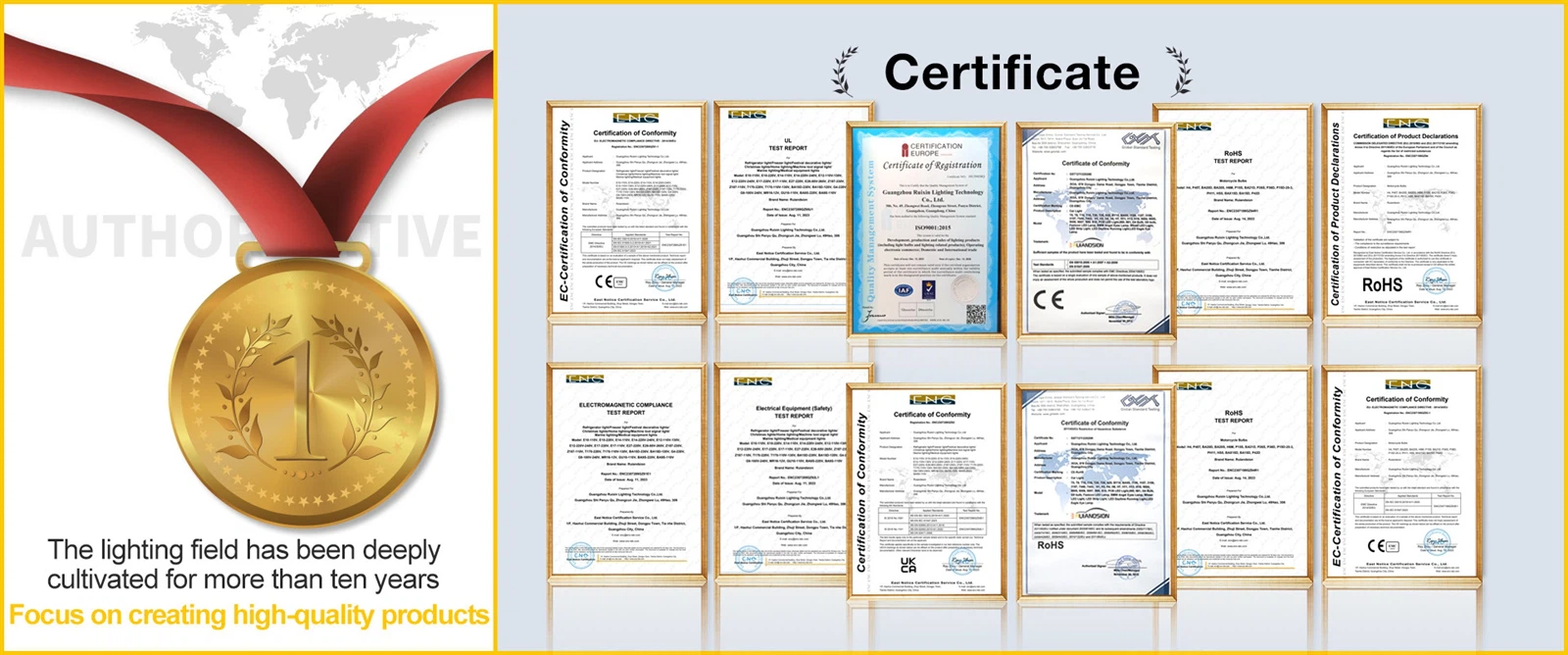

Guangzhou Ruiandsion Lighting Technology Co., Ltd. is a manufacturer specializing in the production of LED lighting for household, medical, industrial, automotive, and motorcycle applications. We have 12 years of production experience and have professional designers, sample craftsmen, quality inspectors, and production equipment. With strict quality management, innovative product technology, and a comprehensive service system, we have established long-term cooperation with customers from 45 countries worldwide.
FAQ
Q: What is automatic light bulb?
Q: How do you identify an auto bulb?
Q: What is the car light bulb called?
Q: What is the most common auto bulb?
Q: How do automatic light bulbs work?
Q: What is the brightest headlight bulb that is legal?
Q: How do I know what light bulb I need for my headlight?
Q: How do I know if my light bulb is LED?
Q: What are the 3 bulbs in a headlight?
Q: What is the voltage of a car bulb?
Q: Do LED lights come on automatically?
Q: Why are automatic lights good?
Q: Which bulb is best for night driving?
Q: What color headlight is best for night driving?
These bright-white bulbs can illuminate even the darkest roadways. During the day, the bulb's blue tint helps to reflect the road safely.
Q: Is your headlight and high beam the same bulb?
Q: How do I know if my bulb is LED or incandescent?
Q: How do I know what type of LED bulb I have?
Q: How can you tell if a light bulb is LED or incandescent?
Q: How do I know if I need a high beam or low beam bulb?
Q: What does 60Hz mean on a light bulb?
The electrical power supplied to the countries of the world is typically 50Hz or 60Hz. The electric power frequency is shown in the number of hertz (cycles per second). This means that the flow of the electrons switch or reverse polarity 50 or 60 times per second.
We're well-known as one of the leading auto light bulb suppliers in China. If you're going to wholesale high quality auto light bulb, welcome to get free sample from our factory. Also, customized service is available.
Fog Light Dual Beam, 1157 auto bulb, motorbike led bulbs